
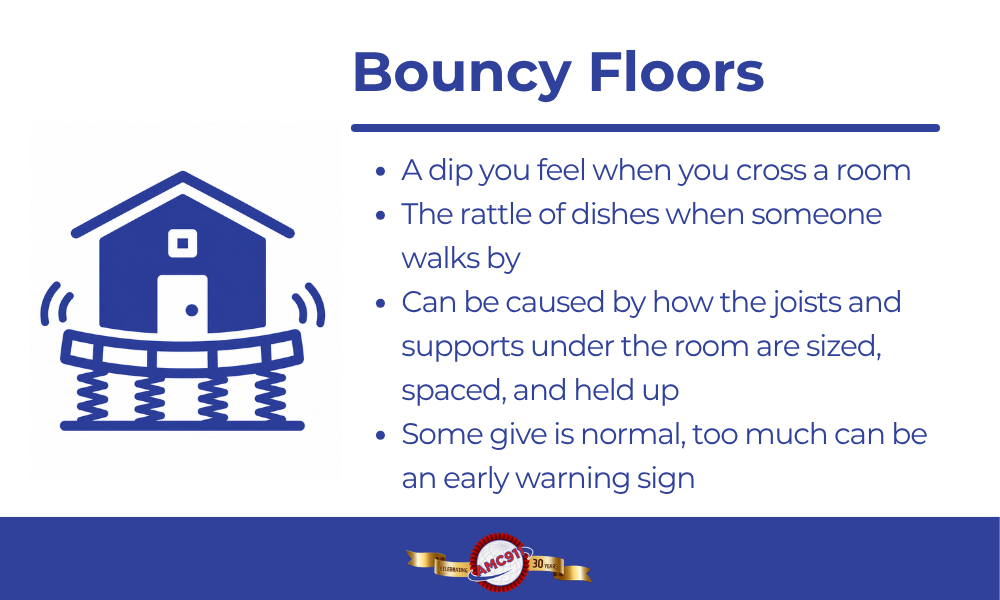
At a Glance: Bouncy floors, also called springy floors, are floors that flex or move more than they should when you walk across them. On a wood-framed floor, the cause is usually in the joists, their supports, or the connection between the joists and subfloor. When those joists are undersized, spaced too far apart, softened by moisture, or short on support, the floor starts to give. A little movement is normal in any home, but too much can point to a problem worth a closer look.
What Are Bouncy Floors?
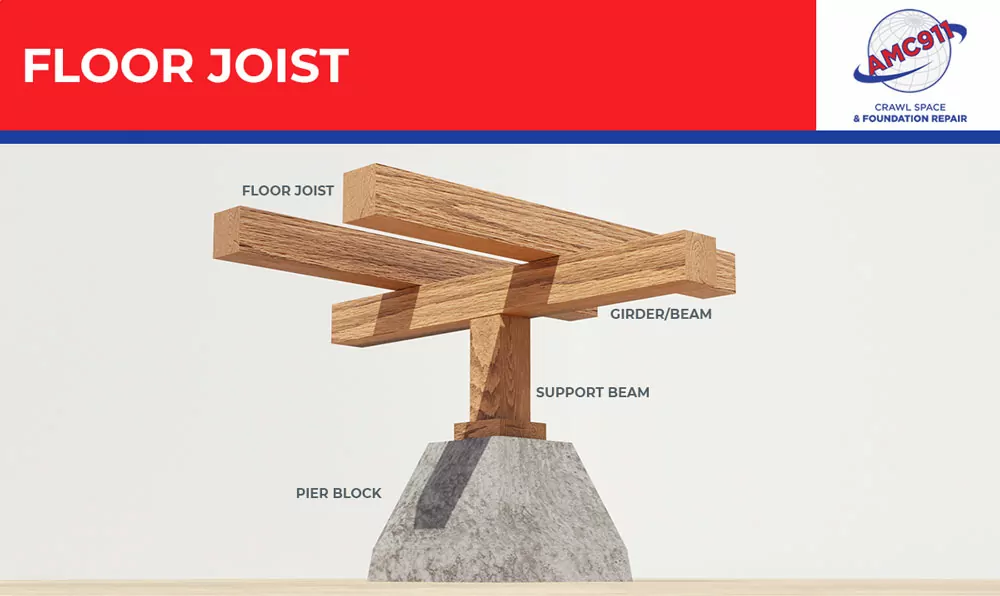
The structure under a typical wood floor consists of a layer of plywood subfloor that sits on top of a row of parallel floor joists. Those joists rest on a sill plate along the foundation wall, with beams and support columns carrying the middle. This whole assembly is your floor system, and it does the quiet work of holding up everything in the room above.
Every floor flexes a tiny amount under weight. Builders and engineers call that small movement deflection. For new residential construction, building codes set maximum deflection limits for floor framing. A floor can meet the minimum design limit and still feel springy to some homeowners, especially across a longer span. A bouncy floor is simply one where the deflection is larger than it should be, so the floor feels springy when you walk on it.
What Causes a Bouncy Floor?
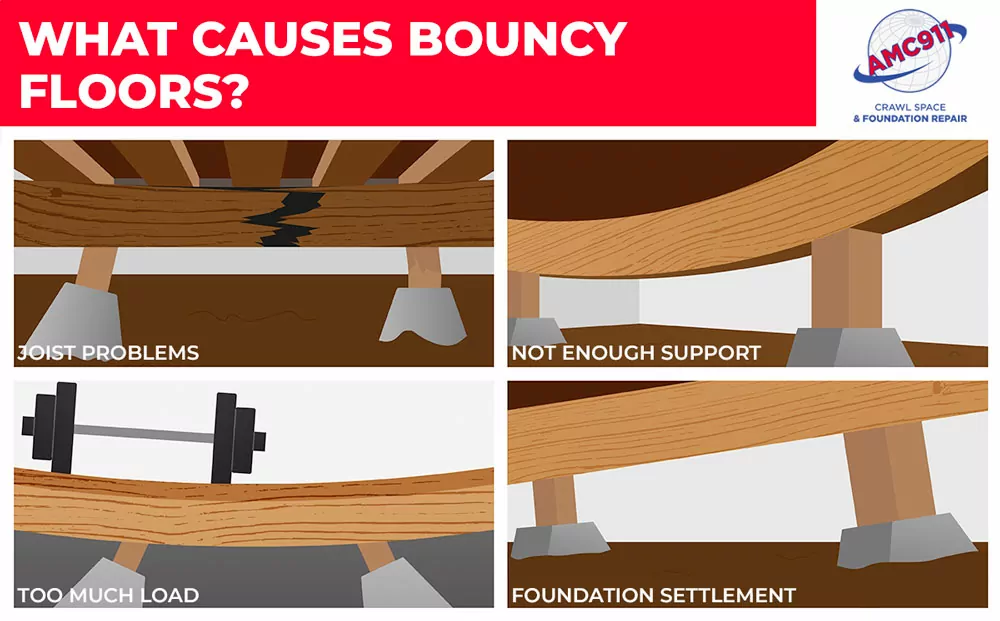
Floor bounce is usually a symptom, not the root problem. Here are the most common causes we find under Hampton Roads homes:
Long Joist Spans
The joist span is the distance a joist covers without support. When that span is too long for the size of the lumber, the joists flex. This can show up in older homes, after a remodeling project, or where the original framing is too flexible for the room’s current use.
Too Few or Widely Spaced Joists
Wider joist spacing gives each joist a larger share of the floor load. Joist spacing has to be evaluated along with joist size, species, grade, span, and the loads in the room.
Missing or Broken Cross Bracing
Cross bracing, the small wood or metal pieces installed between joists, keeps them from twisting and helps them share the load. When it is missing or has fallen out, floors feel springier.
Moisture-Weakened Wood
In a damp crawl space, joists, a beam, or the sill plate can soften from rot and lose strength. Our humid, coastal climate keeps that moisture in play, and wood decays once humidity stays near saturation.
Settled or Undersized Support Columns
When support columns settle into the soil, or are spaced too far apart by the original builder, the floor loses its mid-span support.
Foundation Settlement
Shifting soil under the home can move the whole support system, adding both bounce and uneven floors.
Several of these causes trace back to water and soil, not just the lumber itself. That is why a fix that ignores the crawl space or the drainage around your home often does not last.
When Should You Worry About Floor Bounce?
The good news is that not every springy floor is a major problem. A little give near the center of a long span, or in a large open room, can sit within normal limits. Even a new home can carry some bounce if the joist span sits right at the limit the building code allows, so it’s important to understand the difference.
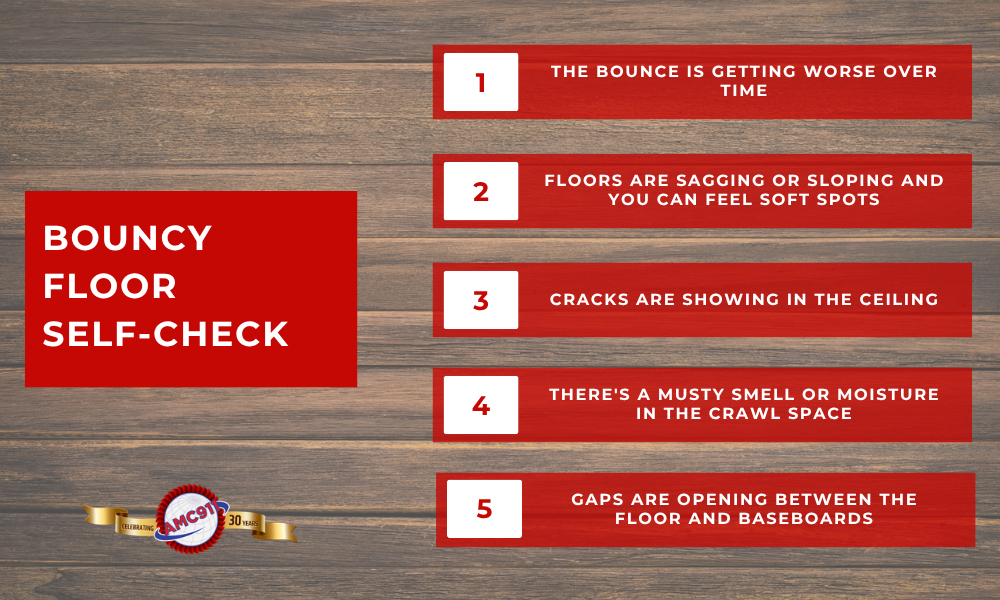
Warning Signs to Look For
If you notice any of these signs, or anything else that strikes you as suspicious, it is worth having a professional take a look:
- Bounce is clearly getting worse over time
- Soft spots or areas that feel like they give way underfoot
- Sagging or uneven floors showing up alongside the bounce
- New gaps are opening between the floor and the baseboards
- Cracks in a plaster ceiling below or along the basement ceiling
- Leaning or cracked chimneys
- Doors or windows that have started to stick
- A musty smell or visible moisture in the basement or crawl space
A single soft spot in one room may be a small repair. Several of these signs together can point to structural issues that have been building for a while.
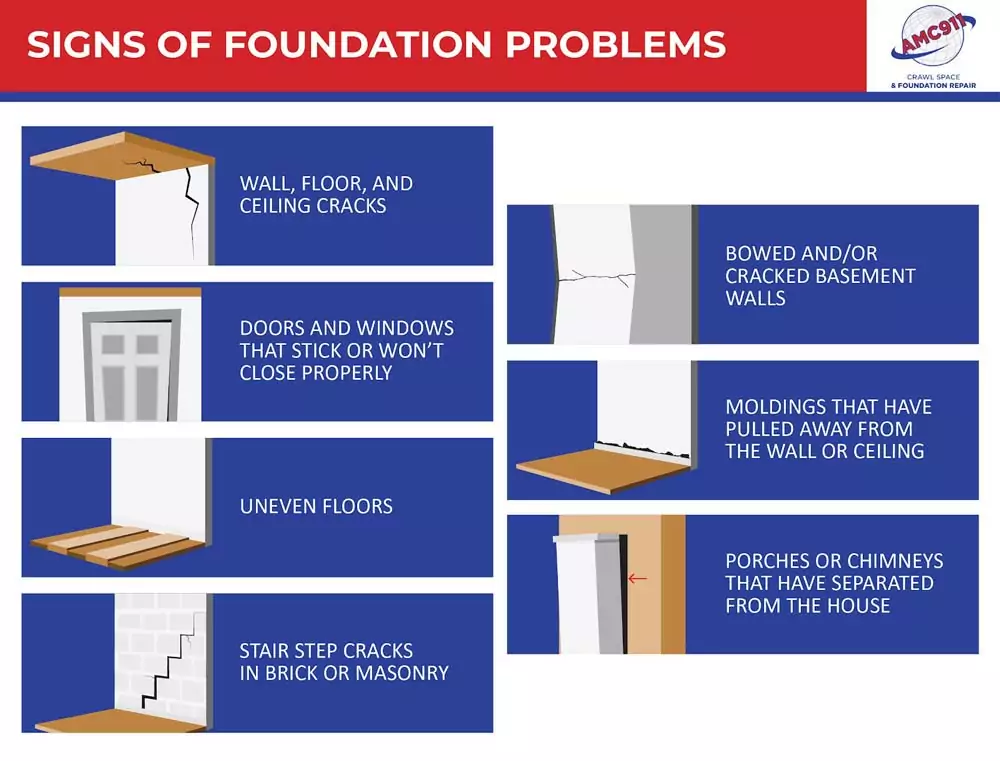
Foundation and structural problems can worsen over time; if you wait, you will usually pay more.
How Are Bouncy Floors Fixed?
The right repair depends entirely on the cause, which is why a good inspection comes first. Fixing a bouncy floor is often not a DIY job.
Start With a Foundation Inspection
Before any repair, an experienced foundation repair contractor inspects the foundation and the floor system from below. Once they pinpoint the cause, they can match it to the correct repair instead of guessing from the room above.
Approaches Used Most Often
- Underpinning. When the bounce traces back to differential foundation settlement, foundation underpinning stabilizes the foundation. Push, or helical piers, are driven into the ground until they reach load-bearing soil or bedrock, then attached to the foundation. Once in place, they hold the foundation steady and can lift it back toward its original position where conditions allow.
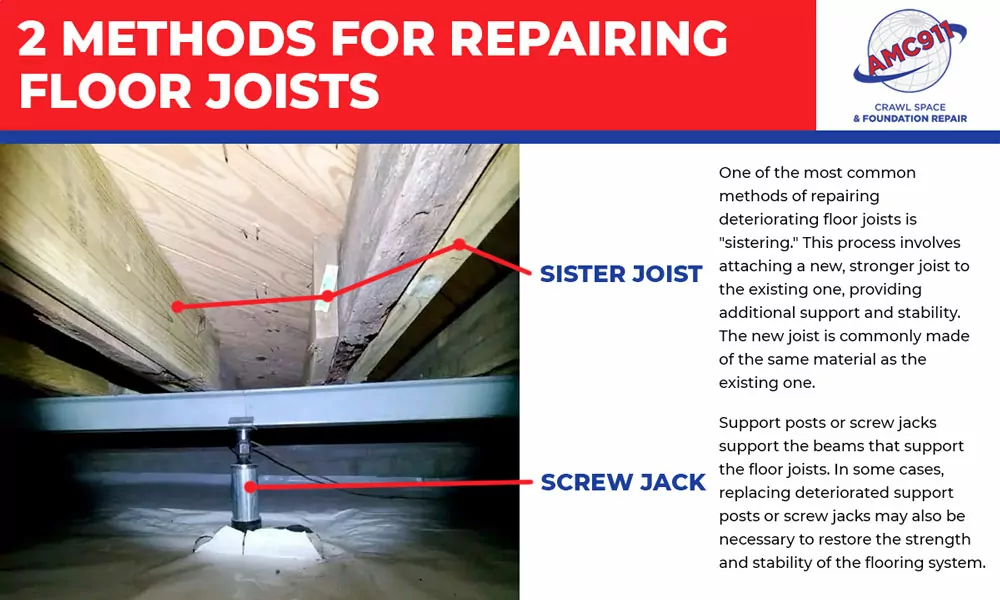
- Floor Joist Repairs. When the floor joists are the problem, sistering is a common repair. Rather than removing the weak joist, we attach a new full-size joist alongside it, bonding them with construction adhesive and fasteners so the existing joists gain stiffness. A full-depth sister member adds the most strength.

- Replace the Support Posts or Install Screw Jacks. Support posts that have deteriorated can be replaced or repaired so they carry the floor properly again. Adjustable screw jacks are also used in some cases, particularly in crawl spaces, where they provide steady mid-span support and can be fine-tuned to the right height.
- Adding Mid-Span Support. Installing a new beam, often wood or steel, on properly placed support columns shortens the effective joist span and calms the bounce.
- Restoring Cross Bracing. Replacing missing bracing between joists helps them share the load again.
- Upgrading Connections. Repairing or adding approved joist hangers and other connectors where framing meets a beam, header, ledger, or similar support can improve the load path and reduce movement.
- Fixing the Root Cause. If moisture weakened the wood or foundation settlement moved the supports, we address the crawl space waterproofing and drainage so the repair holds.
A quick note on slab homes: a concrete floor or slab floor does not bounce the way a framed floor does, since there are no joists spanning underneath. Bounce is a wood-framed floor issue, so the conversation looks different for slab-on-grade homes.
In a worst-case scenario, an ignored bounce paired with rot or settlement can keep getting weaker until the floor becomes genuinely unsafe. Catching it early keeps you far away from that worst-case scenario and keeps the repair simple.
Why a Professional Inspection is Your Best Bet
From upstairs, almost every bouncy floor feels the same. The actual cause, whether it is the joists, a beam, the support, moisture, or the foundation, is only visible from below in the crawl space or basement. Throwing more screws at the subfloor or laying a second layer of plywood might offer a temporary solution, but it will not fix an undersized joist or a settled support column. Guessing wrong wastes money and lets the real problem grow. A trained eye checks whether your floor system meets the deflection limits in the building code, not just whether it “feels” okay.
Reach Out to AMC911 for a Free Foundation Inspection
When our team performs a crawl space inspection, a structural engineer reviews the load path before we recommend any fixes. You get a written estimate, a clear explanation, and honest options. Don’t wait to contact a foundation repair professional if your floors have started talking back.
If your floors bounce, dip, or feel soft, contact AMC911 today to schedule a free inspection. Foundation problems often never get better on their own. Act fast, and you could save money.